Walter Moody
The LuminariesWalter Moody is a legally trained newcomer to Hokitika whose unsettled passage aboard the Godspeed places him at the center of a web of disputed identities, missing gold, and concealed relationships. He listens before he speaks, tests what witnesses call the truth against what is pertinent, and follows physical evidence from a shipping advertisement to a forged bill of sale. His role is not merely to solve the town’s mysteries: what he learns about Crosbie Wells and Alistair Lauderback becomes a personal ethical problem, and his final movements leave that tension unresolved.
Identity and Arrival
Moody arrives in the story as a stranger from the south, carrying the habits of a lawyer into a community whose accounts are shaped by rumor, informal codes, and incomplete records. He has travelled from Liverpool to Dunedin by packet steamer and first set foot on New Zealand soil on 14 January. On that night he looks for familiar stars, but the Pole Star is below his feet and the constellations appear inverted. Orion and Canis Major seem strangely displaced; only when he finds the Southern Crux does he begin to orient himself. The altered sky gives concrete form to the dislocation of his arrival: the old patterns by which he measured his position no longer serve him as they once did.
From Port Chalmers he sails aboard the barque Godspeed, a small vessel with a painted-oak eagle as its figurehead, on a route that bends north through the strait before turning south toward the diggings. His ticket provides only a narrow berth below decks. Because the hold is close and foul-smelling, he spends most of the voyage on deck, crouched below the gunwales with a leather case held against him and his collar raised against the spray. The cramped passage and limited view of the coast make his arrival less a confident entrance than a prolonged separation from what he has known.
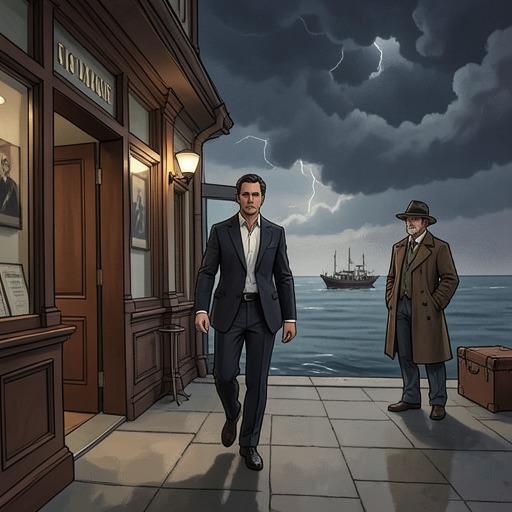
In Hokitika, Moody enters the smoking room of the Crown Hotel, where twelve men have gathered. Their varied clothes and carefully separate occupations make them resemble strangers sharing a railway carriage; rain, rather than the noise of travel, fills the room. This carefully composed public scene becomes the setting in which Moody hears accounts that will gradually connect. When one name provokes a sudden shift in attention, the room’s men turn toward him. His mild expression remains, but the change reveals how quickly a newcomer can become entangled in local affairs.
A Listener Who Tests the Story
Moody enters the evening without intending to disclose what he experienced on his journey. He has barely been able to acknowledge the encounter to himself, much less make it intelligible to others. Yet the stories told in the smoking room give his experience a possible context. He describes seeing a figure inside a shipping case in the Godspeed’s hold, while emphasizing that he cannot be sure it was alive or even properly call it a man. His uncertainty is important: he offers an unsettling observation, not a settled explanation, and leaves room for doubt rather than claiming supernatural knowledge.
He listens closely to the men’s accounts and challenges the confidence with which they connect one fact to another. When Lauderback mentions Dunstan, Moody considers whether that reference is as casual as it sounds and whether Lauderback’s intentions can be trusted. His attention is directed not only toward what a speaker says, but toward why a detail is offered at that particular moment. This makes him a participant in the room’s collective inquiry without turning him into an all-knowing detective.
Moody’s legal training comes to the fore in his distinction between truthfulness and completeness. A witness can speak honestly while still selecting which impressions and facts to include; what counts as the whole truth depends on relevance, and relevance depends on perspective. The distinction supplies a method for reading the novel’s testimony: omission need not prove a lie, but the choice of what to emphasize can still shape a listener’s understanding. Moody’s formulation also describes his own conduct. He is alert to the difference between evidence that can be established and the larger meaning people attach to it.
The story’s structure reinforces his role as a listener. The men’s accounts are directed partly to Moody, while Benjamin Löwenthal hears some of the tale for the first time and responds by recalling an event from about eight months earlier. That shift brings another memory into the room rather than simply advancing a single continuous account. Moody asks how Löwenthal can remember the details so precisely, including the scarred visitor, the date, and the name on a birth certificate. The question presses the narrative to explain how memory acquired its certainty, and how a small written record can lend weight to recollection.
Following the Missing Crate
Löwenthal recalls that a scarred man visited his office on Weld Street in June 1865 to advertise a missing shipping crate. The man offered twenty pounds for its return, or fifty if it came back unopened, and described its contents only as items of considerable personal value. Asked for his name, he produced a birth certificate instead of answering. Löwenthal copied the name Crosbie Francis Wells. Moody’s interest in this episode lies in the way an advertisement, a document, and a remembered face converge—and in the gaps that remain between them.
The timing and precise wording of the advertisement had stayed with Löwenthal because its final word, Wells, would not fit the newspaper column as set. The difficulty of composing the notice made the name unusually memorable. This typographical detail gives Moody a material basis on which to assess a memory that might otherwise seem too exact after so many months. It also draws attention to the way identity is carried by documents and printed words: Crosbie Wells is not present in the office as a fully verified person but appears through a name written from a birth certificate and preserved in a newspaper’s production history.
Later, a message tells Moody that the Godspeed’s cargo has been cleared and his trunk delivered to his room at the Crown Hotel. The arrival of his possessions prompts him to hurry upstairs, eager to recover a connection to his former life that has felt unreal since the shipwreck. In the trunk he finds a leather briefcase containing contracts, receipts, and bills of sale. He carefully handles the document recording the Godspeed’s sale and examines the purchaser’s signature, which is made in the name Francis Wells.
The signature seems deliberately ambiguous. A large flourish beside the capital F can be read as a C joined to the following letter, while a dot of ink between the letters might be dismissed as a blot or taken as part of the writing. Moody sees that the signature could suggest C. Francis Wells as well as Francis Wells. The slow, shaky penmanship appears designed to produce that uncertainty. Here his observation of the document turns a name into a clue: the bill of sale may connect the ship’s purchaser to the man advertising the lost crate under the Wells identity.
The Letters and the Choice to Conceal
In the same trunk Moody discovers a bundle of about fifteen letters addressed to Lauderback. Their plain handwriting and arrangement in reverse chronological order make them a private archive with a visible history. He notices the knot and the bow’s strings before undoing them, then selects the earliest letter and reads it. The correspondence reveals that Crosbie Wells and Lauderback were brothers. Moody understands at once that Lauderback has not disclosed this connection when discussing Wells’s death, either to the magistrate or to his friend Thomas Balfour.
The discovery gives new significance to several competing identities and silences. The letters connect the man named on the birth certificate to a politician who has not acknowledged him, and Moody wonders whether shame over Wells’s illegitimate parentage explains the concealment, or whether another reason is at work. But the correspondence is also private, and its evidentiary value creates a practical dilemma. Moody considers copying it, returning it to the trunk, stealing it, or handing it to an authority in Hokitika. He recognizes that it may matter greatly if a Supreme Court judge is called, yet he also knows that its relevance does not automatically make its exposure ethically simple.
He ultimately tells no one that Wells was Lauderback’s half-brother. He gives several reasons: a man should not be made answerable for his family, and private correspondence should not be exposed without consent. Those principles do not fully account for his silence. Moody has repeatedly compared himself with both men and feels a different kind of kinship with each: with Wells in his desperation, and with Lauderback in his pride. His withholding of the news therefore reveals a divide between professional judgment and personal identification. He does not simply fail to report evidence; he declines to make himself the agent of an exposure he finds morally intimate.
Law, Evidence, and Departure
Moody’s concern with the boundary between provocation and lawful action appears when he confronts Ah Sook over the prospect of revenge against Francis Carver. He warns that taking Carver’s life would lead to Ah Sook’s execution, regardless of the provocation. The warning expresses Moody’s practical understanding of unequal consequences: an act may feel justified to the person who performs it and still be punished by the institutions that control the outcome. Elsewhere, Ah Quee describes the law as united against Chinese men and calls for solidarity in response. These competing perspectives place Moody’s legal counsel within a world where the formal system is not experienced as neutral by everyone.
At the court proceedings, Moody makes his training useful as a method of comparison. He directs attention to the signature on Lauderback’s private letters, which matches the signature on Crosbie Wells’s marriage certificate and on a deed of gift dated 11 October 1865. That deed records a proposed payment of two thousand pounds from Emery Staines to Anna Wetherell, with Wells as witness. Moody contrasts those signatures with the one on the Godspeed bill of sale, which does not resemble them, and argues that the sale document is forged. Rather than relying on a witness’s confidence or a name’s appearance alone, he sets several documents beside one another and shows how their differences bear on the contested identity.
His final departure is marked by the return of ordinary possessions and clothing rather than by a declared resolution of the mysteries. On the morning he prepares to leave, he folds his fine clothes into the trunk, secures it, and dresses in yellow moleskin trousers, a red neckerchief, a plain wool coat, and a broad-brimmed hat. He takes his belongings on his back and leaves his room. When offered company, he accepts and gives his name as Walter Moody. The exchange returns him to the status of newcomer with which he began, but now the name is spoken after a journey through other people’s documents, aliases, and concealed histories.
Moody’s narrative importance rests in that double position. He is both an interpreter of evidence and a person altered by what evidence discloses. He tests memories, signatures, and testimony, but the half-brotherhood he uncovers cannot be reduced to a legal finding for him. His judgment is careful rather than absolute; he recognizes that relevance changes with perspective, and that some truths carry obligations as well as explanatory power. In a town where identities can be assumed, proved, or withheld through paper, his own most consequential decision is not only what he discovers, but what he chooses not to reveal.